I have subscribed to your TSM for
three months and am thinking of renewing my subscription. I am a
little confused with the performance and the position table,
especially the sell price you post in your website. It looks like if
the price hits your initial profit target, then your position table
will show that the trade is exited at the initial profit price. If
the price doesn't hit your target, then you will be able to exit the
trade few pennies below the high (for long position). How do you
determine whether to wait until the price hits the target or to exit
the trade before it hits the target (it may never hit the target)?
How can you constantly exit the trade right under the high (for
long) when you decide not to hold the position?
For example, there are two trades on
4/24/2008.
From your report for
4/24/2008:
Trade Management
Update: [08/04/23] GYMB didn't hit our buy point Wednesday so
let's use a new buy range for tomorrow: 41.06 to 41.56 with a new
target profit point 43.31.
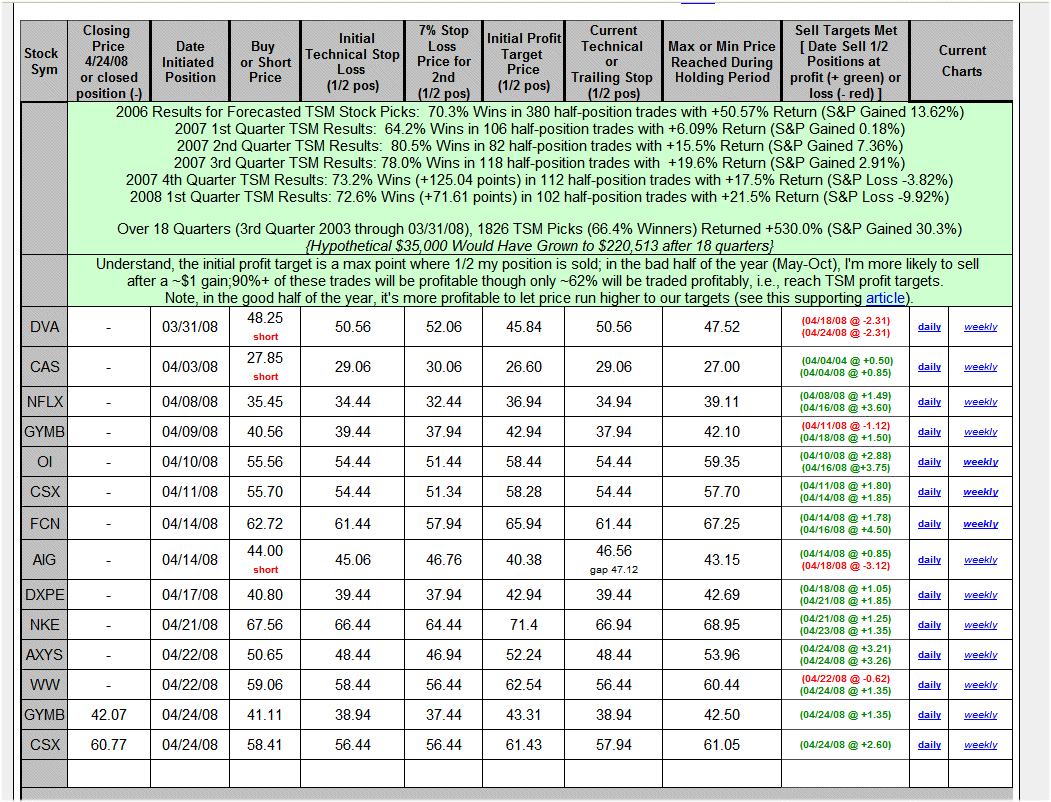
On 4/24/2008, the price
range for GYMB is 41.01 to 41.50. your position table shows that 1/2
position is sold @42.46 (41.11+1.35). Would you please tell me what
is your exit strategy on this trade? My understanding is we won't
sell 1/2 position yet since 43.31 is not hit. How do you determine
to sell 1/2 before target is hit and when or at what price level you
would sell 1/2 before target is hit? why?
Let us look CSX. On
4/24/2008, the price range is 58.3 to 61.05. While your report
suggested that a initial target is 61.43, your position table showed
that 1/2 position was sell @61.01, four pennies below the high.
Many similar examples can
be found in position table you post in your website. I must miss
something. Would you please help me out.
Thank you.
Jim X. (04/26/08)
**************
TSM's Answer
First
, let me say that I view my obligation to subscribers as two
fold:
- to identify
fundamentally sound stocks that are set to move
higher in the near future (and the converse for
shorts),
- to identify stop-loss
points that should be honored religiously (I'm right
70+% of the time, but the key to taking money from
the market consistently lies in one's ability
to control loses that 30% of the time you're wrong);
therefore, with every trade, I provide two stop-loss
points for each half of the position (the first
based on technicals
and the second 3 percent below
the first).
Having said that,
I suggest a profit taking target for first 1/2 of the
position. But as far as I'm concerned you need
to set your own profit targets. Your particular methodology dictates
the sell profit points you're happy with. For
instance, you might wish to stay longer to build
greater profits. For me, the first half
position's profit target is short term. I try
to sell the first half of each position at ~$1 gain
(~$0.75 for $20 stocks) or at the forecasted target
if the market looks good that day, and the stock is
rising. I would then let the second-half
profit run higher and use the low of the prior two
days as a trailing stop to exit. In today's
market, however, with all its volatility, I prefer
to take profits more quickly then move on to the
next trade. The exact profit points are
dictated intra-day by the market's behavior.
It's something that cannot be determined the night
before.
My interest lies primarily with the day trading aspects that I
write about. I have trading accounts totaling ~1.5 million
but actively trade a $90k account for which I aim to achieve a 1
percent daily gain. While the folio that TSM is following
is my actual folio (set up originally to evaluate the TSM
benefit of trading a small account), I don't trade all the TSM
forecasted trades (usually ~ 75 percent of them) because I
prefer $100+ TSM stocks trading more than 3 million shares daily
and a much shorter time frame than the average 7.1 day TSM
trade. The forecasted trades not actually made are paper
traded to their fruition. To give you a better idea,
the following is a list of my completed trades for the week of
4/21/08 through 4/25/08. Thirty of the 32 trades with
these 11 stocks were profitable. The total gain for the
week amounted to 4.37 percent of the trading account.
Note, this is the net gain after commissions were deducted.
This week, only SYT and NKE were taken from the daily forecast
though AXYS, WW, GYMB and CSX all provided profitable
opportunities.

How Does the TSM Trading Range Work for
Entering a Trade?
My historical analysis (remember, I'm a professional
statistician and data analysis is my forte) (Trading Pullbacks
, Pullbacks versus 21-Day Highs and Lows,
Buying Pullbacks), as well as that of Larry Connors, has shown that pullbacks of
fundamentally sound stocks offer far more profitable entries
than do breakouts. Further, they're less risky in today's
market. Consequently, I not only try to buy these stocks
as they move though a muti-day pullback, I also try to buy them
tomorrow on a slight pullback from today's close.
Therefore, I forecast an entry range that tries to get you into
the trade at a lower price than would be projected from a
breakout entry. You might target the midpoint of the
range.
Let's consider the CSX trade as an example. First,
consider the fundamentals that were offered in TSM's "Before the
Bell" report.
-
Both it's
industry and the stock itself is under accumulation, and
since 85 percent of the market's trade volume is
institutional, that's institutional accumulation;
-
Zacks ranked it
a 1 which reflects upward earnings revisions;
-
PEG (price to
earnings to earnings growth) are well below one which shows
that the current price is very undervalued;
-
These facts
lead to CSX's membership in four of TSM's six fundamental
screens and a membership in Zacks fundamental screen;
-
Earnings and
sales have risen steadily over the past four quarters;
-
It's trading
close to its 52-week high;
-
Its earnings
estimates for the current year have been increased by 18.8
percent in the last 90 days.
Truthfully,
forecasting the CSX trade was a no brainier, a license to print
money.
From TSM's Thursday (4/24/08) Daily
"Before the Bell" Report ...
Company Profile: CSX
Corporation provides rail-based transportation services in North America. The
company offers traditional rail service and the transport of intermodal
containers and trailers. It also provides coast-to-coast intermodal
transportation services linking customers to railroads, through trucks and
terminals. CSX Corporation transports crushed stone, sand and gravel, metal,
phosphate, fertilizer, food, consumer, agricultural, paper, and chemical
products. In addition, it delivers coal, coke, and iron ore to electricity
generating power plants, as well as finished vehicles and auto parts. The
company also engages in the real estate sale, leasing, acquisition, and
management and development activities; the operation of a resort; and leasing
equipment and vessels. As of December 28, 2007, it operated approximately 21,000
route mile rail network, 4,000 locomotives, and 222,000 freight car fleet,
serving various population centers in 23 states east of the Mississippi River,
the District of Columbia, and the Canadian provinces of Ontario and Quebec. CSX
Corporation was founded in 1827 and is based in Jacksonville, Florida.
Company Fundamentals: CSX is a 23.94 billion market cap
company. Its sector is Transportation; its industry, is currently under major
accumulation by institutional investors (top 9 percent of all industries)-held
steady at 6 percent three weeks ago. CSX itself, however, has been under
accumulation by institutions as shown by its 91.0 accumulation/distribution
ratio. Zacks ranks CSX a 1 ranked 1 four weeks ago). PEG ratios of 0.39 and
0.89 for the next two years reflect the value left in the price (read about the
effectiveness of PEG ratios in forecasting value
here
, though it has increased 32.89 percent in value over the past six months (S&P
500 decreased -8.39 percent). CSX reports earnings on 7/16/08.
It is a member
of four of the six TSM fundamentals screens and a member of a Zacks earnings
revision screen. Over the past two quarters, it has averaged a 21.2 percent
positive surprise and produced a 22 24 49 60 (most recent quarter) percent
year-over-year earnings growth and 5 4 8 11 (most recent quarter) percent
year-over-year sales growth (producing 11.0 billion in sales this year). Its
Price/Sales ratio now stands at 2.18, and it's currently trading at 97 percent
of its 52-week high. Further, this year's earnings estimates have increased
their numbers by 18.8 percent from 3.04 to 3.61 in the past 90 days.
Technicals: This great company has been pulling back to
the support of its rising 20-day moving average. This is an opportunity to buy
it as it pullbacks a little further.
Even with great fundamentals, I would like to buy Thursday at a
lower price ($58.06 to $58.76) than CSX closed at on Wednesday
($59.36). Having said that, I would also like to enter the
trade, and I run the risk of missing it altogether if it were to
gap up. If that were to happen, however, I would
just go on to the next trade. In this business, there's
always a next trade. In today's volatile market, it's
worth building a cushion at the entry so you're not as likely to
be stopped out later. Further, losses are tempered.
Remember, over the longer/intermediate term we're currently in,
the market is bearish so all long trades tend to swim against
the current.
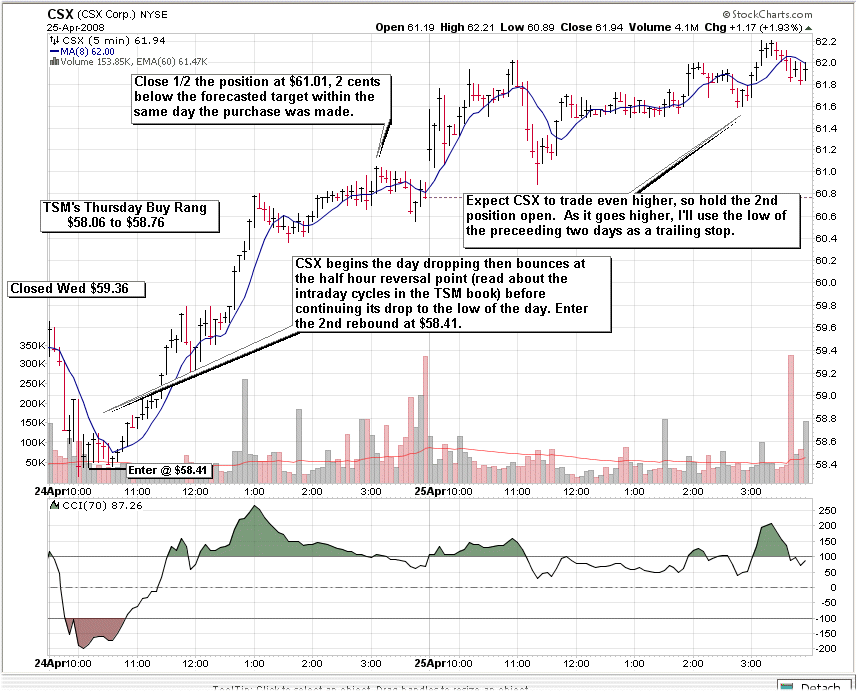
Thursday, CSX fell over the first half hour then bounced higher
over the next few minutes. This behavior is
characteristic, i.e., the first reversal at the half hour occurs
routinely (see the TSM methodology book for a description of
common intra-day cycles). Therefore, I waited to enter
after the bounce when the down trend resumed. When this
downtrend then turned higher, I entered the trade at $58.41.
The trade turned bullish, and I closed the first half of the
position in the same day for a $2.60 gain (40 cents or so under
the price target). I remain in the trade and expect it to
move higher from here. I've raised the stop-loss point to
$57.94, but may take the 2nd half profit sooner should the
market turn bearish.
Again, my offer to you (at only $25 monthly for a 100 of you) is to get
you into go trades and establish stop loss points. Profit targets,
on the other hand, are individual preferences.