TripleScreenMethod.com
Three-Year Trends in Sector Rotation
from www.CANSLIM.net (published December 2006)
Richard W. Miller, Ph.D.
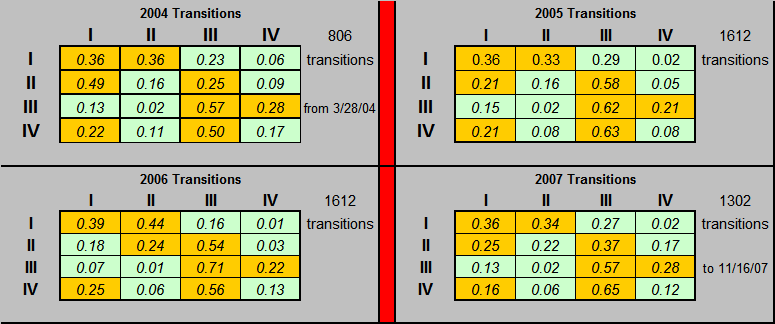
In the August 2005 issue of Canslim.net News, I provided an initial assessment of month-to-month sector rotations. I followed that with an updateon my further research in the January and August 2006 issues, and now I’ve now finished 2.7 years of data collection (through 11/24/06) [now updated through 11/16/07]and want to provide further insight into the market rotation cycles of 31 market sectors (806 month-to-month rotations in 2004, 1,612 in 2005, 1612 in 2006 and 1302in 2007). These macro-rotation cycles drive the market from one group of stocks to another, regardless of company fundamentals.As I discussed in earlier reports, this approach uses Markov Chain Analysis (MCA) to assess transition probabilities. One starts by defining the statesof the system under study. To that end, I define four (called quads) based on sector performance over a combination of their past one- and three-month periods:quad I (both returns negative [sectors bearish]), quad II (1 month positive, 3 month negative [sectors breaking out]), quad III (both returns positive [sectorsbullish]), and quad IV (1 month negative, 3 months positive [sectors pulling back]).MCA enables one to assess transition probabilities among these four states on a month-to-month basis. The resultant probability matrix is then usedto answer questions pertinent to the trader: Is it more profitable—have a higher probability of success—to buy good stocks in poorly performing sectors (sectorsin quad I) or good stocks in the best performing sectors (sectors in quad III) or good stocks in sectors pulling back (sectors in quad IV)?How can a trader use this information? The question is answered from the probabilities with which these sectors rotate through quadrants. That is,if I’m interested in a sector currently in quad II, what are the chances that it and its component stocks will continue to do well and find itself in quad III next month?Or, on the other hand, fall back into a more negative quad I? Too, do these sector-rotation probabilities change over time as market health and the business cycleevolve?The table addresses the second question, showing probabilities for transitions from one quad to another over the last three years. For example, in 2007there was a 0.39 probability that a sector in quad I would find itself there the next month (0.36 probability in 2004, 0.36 probability in 2005 and 0.39 probability in2006) and a 0.34 probability that it would move to bullish quad II (0.36 probability in 2004, 0.33 probability in 2005 and 0.44 probability in 2006). Obviously, oncea sector enters the bearish quad I category, it has had a tendency either to remain there or move into bullish quad II. On the other hand, It's far less likely to moveinto quads III or IV.The gold areas highlight the most favorable two transitions for each quad. A sector finding itself in quad II (positive performance over the last monthbut negative over the last three months) might continue its positive performance and remain in quad II or move over into a more bullish quad III. In 2004, therewas only a 0.41 probability of that happening, but in the next few years, those rotations became much more likely: in 2005 (0.74 probability), in 2006 (0.78probability) and in 2007(0.59 probability).Another consistent rotation over the past four years has been sectors in quad III, remaining in quad III and sectors in quad IV moving back into quad III.It’s a behavior typical for a strong performing sector consolidating itself in a pullback before resuming its bullish run.The biggest change over the four-year period has been with the transitions from quad II. In 2004, there was a much greater tendency to for sectors inthis quad to fall back into bearish quad I. In 2005, 2006 and 2007, this changed to a greater tendency to move into bullish quad III.Two qualifications to bear in mind: (1) this analysis assumes no difference in the behavior of individual sectors, i.e., all 31 sectors are equally likely tomake the same type transitions; (2) a few of the transitions are difficult—though not impossible-- e.g., the quad I to quad III transition, i.e., from a state where bothone and three month performances are negative transitioning to one where both are positive.These matrices are best used to find opportunities and to assess holdings for their likelihood for change. This year, like the last three years, the bestsector-related opportunities have come from entries into quad III and pullbacks from there into quad IV. Of course in either case, we buy the fundamentally soundstocks in the sector. On the other hand, the best shorts will come from the least sound stocks in sectors entering quad I.Market health and sector rotation cycles dominate the performance of individual stocks. One needs to be aware of both when trading or investing instocks.