TripleScreenMethod.com
Up to three-quarters of any stock’s price movement results from a combination of overall market conditions and specific sector strengths. Yet most traders pay scant attention to either, opting instead to spend the majority of their time picking stocks. They don’t care about the six-month, the Presidential or the decennial cycles that highlight significantly better times to be in the market. For example, if you had invested $10,000 in the Dow in 1950 independently in the May 1-to-Oct 31 and Nov 1-to-Apr 30 periods—taking your money out of the market when the respective six-month period was done—by Oct 24, 2003, you would have only $9,466 remaining in the first account and $471,355 in the second. Further, you would have been exposed to far less market risk being out of the market for six months each year.
Most traders don’t understand either the sector rotation cycles driving the market from one group of stocks to another, regardless of company fundamentals. Recently, for example, housing stocks dominated the market after breaking out late last year, only to sell off in July, many pulling back to the support of their 50-day moving averages. Energy is another sector that may be rotating from favor now, or at least pulling back.
Often these rotations are predictable from the state of the economy in the current business cycle. For example, when the Fed increases short-term interest rates yet the yield curve flattens because long-term rates are beyond their control (reflect the supply/demand balance and the buying power from foreign central banks), institutions, like banks, that depend on an interest rate arbitrage fall from favor. Obviously an awareness of sector-rotation models can improve your trading.
I have tracked the rotation of 31 sectors for several years. Here I want to share the approach and present data modeled from the past two years. Specifically, I have tried to attach probabilities to answering the question: Is it better to buy the best fundamental stock in the worst performing sector (a contrarian approach) or the best fundamental stock in the best performing sector (a momentum approach)? From my perspective, as a techno-fundamentalist, I always buy stocks with the best fundamentals, albeit ones that are signaling buy from a technical perspective.
The approach is called Markov Chain Analysis. One starts by defining the states of the system under study. Here, we’ll define four states (quads) based on sector returns over the past three months: “I” (both returns negative), “II” (1 month positive, 3 month negative), “III” (both returns positive), and “IV” (1 month negative, 3 months positive). The following shows the state of the market as of 9/9/05.
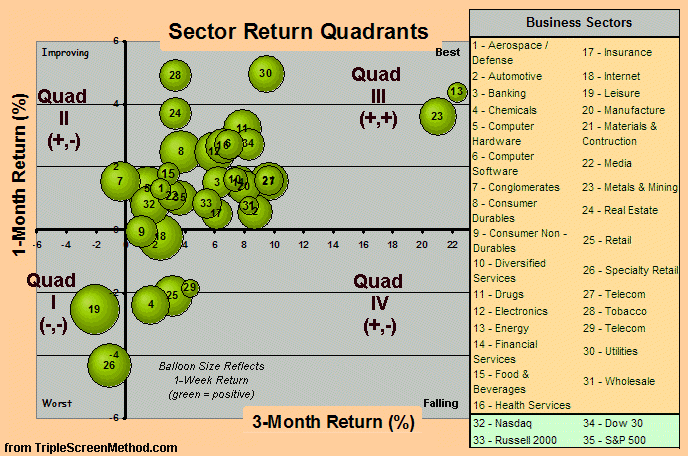
After defining the four states, one looks at state-to-state transitions, for this work, on a month-to-month basis. Markov Chain Analysis, which is straightforward but something I won’t go into here, can then be used to assign probabilities to the transitions between states. The resultant probability matrix can then be used to answer that question most pertinent to the trader: Is it more profitable—have a higher probability of success—to buy good stocks in poorly performing sectors or good stocks in the best performing sectors?
The approach is the same one used in baseball to assess the likelihood of scoring under different sets of circumstances, say when there’s one out in the inning and a runner on first. Let’s say the probability is 20% (one chance in five). I then can look at transition defined by the hitter attempting to deliver the ball to right field, behind the runner in a “hit and run” play. Perhaps my odds change to 30% success. My point is that a trader, once armed with a set of probabilities defining the sector state-to-state transitions, can use them to his advantage. He or she won’t be right every time, but the odds will be in his or her favor.
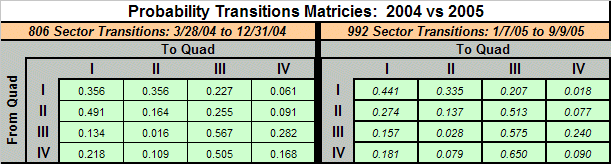
So all well and good, but how does one use this information? The question of most interest concerns the probabilities with which these sectors transition among quadrants. That is, if I’m interested in a sector currently in quadrant “II”, what are the chances that it will continue to do well and find itself in quadrant “III” next month? Or, on the other hand, fall into a more negative quadrant “I”? Too, do these rotation probabilities change over time as market health and the business cycle evolve?
In 2004, a sector in quad “II” had a 49.1% chance of falling back into quad “I” and an additional 9.1% chance of jumping directly to quad “IV” over the next month. Both transitions would mark continued poor performance. In 2005, however, these probabilities changed to 27.4% and 7.7%, respectively. There was a much better chance of continued good performance, i.e., a 65.0% chance of either staying in quad “II”, which would indicate another good month, or transitioning into quad “III”. In 2004, there was only a 41.9% chance of better performance for those sectors finding themselves in quad “II” the month before.
In 2004, a sector in quad “I” this month (the worst performing sector) transitioned to better performing quads “II” and “III” by the next month 58.3% of the time, 54.2% of the time in 2005. Both years had a positive bias to the contrarian strategy, i.e., buying good stocks (not part of this analysis but for me a given) in the worst performing sectors. Only 35.6% and 44.1% of the time did one of these sectors not transition from quad “I” by the next month. On the other hand, a sector in quad “III” this month (the best performing sector) transitioned out of it by the next month 43.3% and 42.5% of the time, respectively, for 2004 and 2005. That sector, on the other hand, continued in quad “III” 56.7% and 57.5% of the time, respectively.
Strategies utilizing either the contrarian or momentum approach offered a positive performance bias. Both approaches proved successful. In developing a trading watch list, most traders would do well to look for opportunities in sectors that are in quad “I” as well as those just entering quad “III”.
Two qualifications to bear in mind: (1) this analysis assumes no difference in the behavior of individual sectors, i.e., all are equally likely to make the same type transitions; (2) a few of the transitions are difficult—though not impossible-- e.g., the quad “I” to quad “III” transition, i.e., from a state where both one and three month performances are negative transitioning to one where just the three months performance is negative. The above matrices are best used to find new opportunities and to assess holdings and their likelihood for change. Presently, the best opportunities have come from Sector “IV”, a sector that has performed well over the longer period, but pulled back in the recent month.
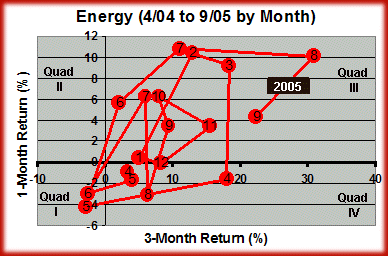
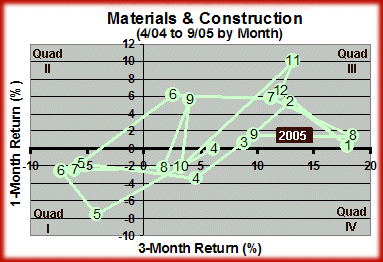
Let’s finish with three examples: Energy, Materials & Construction and Internet. The following chart shows how the Energy sector has transitioned over the past two years. Note, the circled numbers show months. This past May, Energy had transitioned from quad “IV” to quad “I”. From there, over the past three months, it has remained in quad “III”, though this last month of pullback has moved the sector closer to transition.
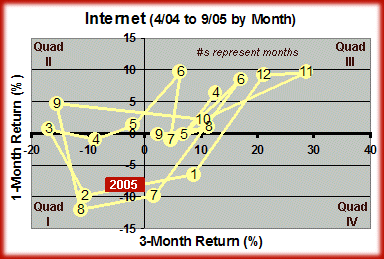
The Internet sector has given us a wild ride over the past few months transitioning from quad “III” in December to quad “IV” in January to quad “I” in February to quad “II” in March back to quad “I” in April, quad “II” in May, and in or close to quad “II” the rest of the year. An ideal trade for the sector would have been to buy the lows of last August.
The Materials sector offered a good buying opportunity at the lows (quad “I”) of last May which were then followed by several months spent in quad “III”.
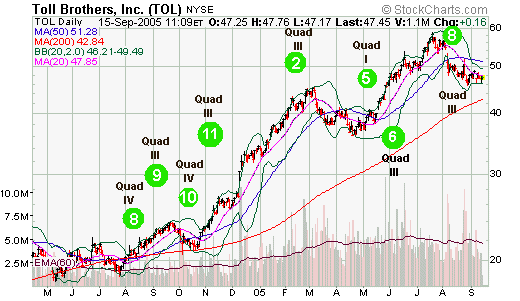
Toll Brothers, a member of the Materials sector, shows how it tracked with the sector over the past two years. The pullback in October from quad “III” to quad “IV” offered a great entry point for the run up to come. Remember, sectors in quad “IV” have transitioned back to quad “III” 65% of the time this year.
In conclusion, going back to the original chart showing the present market, it looks like there may be some contrarian opportunities offered in the recent pullbacks of the Internet, Chemicals, Retail and Telecom sectors (all in quad “IV”) and the Leisure and Specialty Retail sectors (both in quad “I”).