TripleScreenMethod.com
Further Trends in Sector Rotation, a Markov Chain Analysis (8/05/05)As John Waggoner said in a U.S. Today article entitled "Use Care if Rotating into Sector Funds," 'sector rotation means buying industries that have been faring well and avoiding those that haven't. It's a branch of momentum investing, whose main premise is that objects in motion--such as stocks--tend to continue in motion."Three-quarters of any stock’s price movement results from a combination of market conditions and sector strength. Yet most investors spend the majority of their time picking stocks, not in understanding the sector rotation cycles that drive the market from one group of stocks to another, regardless of company fundamentals. Often these rotations are predictable from the state of the economy in the current business cycle. For example, as interest rates run up, banks fall from favor because their profit margins are expected to fall. They are in the business of borrowing short term and lending long term, an approach that doesn't work in a flattening yield curve environment. Obviously an awareness of sector-rotation can improve your trading.
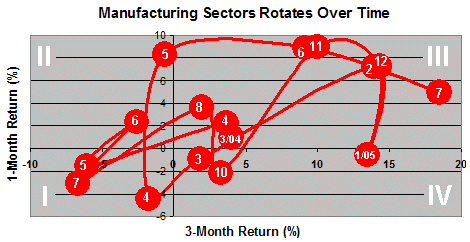
I introduced a method to track sector rotation in the April issue of CANSLIM.net News. In this issue I contrast sector rotation from March 2004 through July 2005: thirty-one sectors had 806, one-month transitions for each year. Consider the manufacturing sector shown in the chart.
Monthly returns produced by the manufacturing sector are plotted for 1- and 3-month periods during the past 17 months. The chart divides the return space into four quadrants: I (both returns negative), II (1 month positive, 3 month negative), III (both returns positive), and IV (1 month negative, 3 months positive). Numbers represent months, and lines track sector movement. For example, the manufacturing sector started in quadrant III (3/04), spent the 4th month there too then rotated through quadrants I, II and back to I over the next three months.
That's all well and good, but how does one use this information? The most important question concerns the probabilities with which these sectors transition among quadrants. That is, if I’m interested in a sector currently in quadrant II, what are the chances that it will continue to do well and find itself in quadrant III the next month? Or, on the other hand, fall into a more negative quadrant I? Further, do these rotation probabilities change over time as market health and the business cycle evolve?
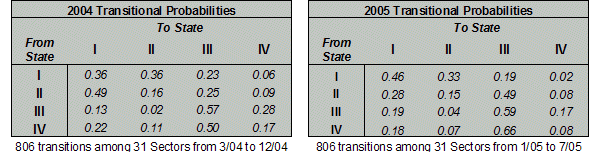
The Markov Chain approach introduced last time starts by counting the quad-to-quad transitions among the 31 sectors over the last 12 months (806 for each each year) then uses a contingency-table approach to convert those numbers to probabilities. For example, in 2004 there was a 0.57 probability that a sector in quadrant III would remain there over the next month, but only a 0.36 probability that a sector in quadrant I would remain there. These probabilities changed to 0.59 and 0.46, respectively, in 2005.
In 2004, a sector in quadrant I had a 0.64 probability of transitioning into one of the three better quadrants over the next month, so buying the best stock in an out of favor sector proved profitable. By 2005 that probability had dropped to nearly a 50/50 proposition. Sectors in quadrant II were most likely to fall back into quadrant I in 2004, but that too changed in 2005 where they were most likely to transition into quadrant III. Over both years, sectors in quadrant III were most likely to stay there over the next month, while sectors in quadrant IV were most likely to improve to quadrant III.Last year an argument could be made for buying the best stock in the worst performing sector. This year it’s clearly paid off to buy quality stocks currently in quadrants II, III, and IV, as over the next month, they either remained in quadrant III or transitioned there. As an example, the manufacturing sector spent 13 months in quadrants II, III and IV and only 3 months in quadrant I.
Putting it all in prospective, buying fundamentally sound stocks with earnings revision fuel and value left in its price is a profitable strategy (TripleScreenMethod). Adding technical entry strategies and an awareness of sector performance improves that strategy.