TripleScreenMethod.com
Market Health and Sentiment Indicators: Put/Call Ratio and VXO
by Richard W. Miller, Ph.D. published in July issue of CANSLIM.net
In past issues of CANSLIM.net News, I’ve written about three measures of the state of the market: the yield curve (June 2005), the NYSE bullish percent, a measure of the percentage of NYSE companies giving bullish “point & figure” signals (May 2005), and the number of stocks, with shares priced greater than $10 and trading at least 100,000 shares daily, currently trading below their respective 200-day moving averages (May 2005). In this issue, I consider two additional measures of market sentiment.
Traders use measures of market sentiment to gauge imminent change in the stock market. More often than not, these provide contrary signals. A good example is the magazine cover where a story bullish enough to make the cover of a major financial magazine frequently spells its reversal. Fortune’s EBAY Oct. 18, 2004, cover article is an example. Within a few weeks after publication, EBAY topped.
The reason sentiment indicators as a group act as contrary indicators is that by the time they provide a bullish or bearish signal, like making the cover with a bullish story, everyone that wants to own or get rid of the stock already has. In the case of the bullish cover, the major institutions already own the stock so there is little additional buying pressure to overcome any selling. Before you know it, selling pressure overwhelms, the stock falls, others join in profit taking, and the stock falls further.
Two of the more useful contrary sentiment indicators are the CBOE (Chicago Board Options Exchange) equity put/call ratio and the OEX volatility index, the latter taken from the implied volatility of the OEX options. The first is a ratio of the volume of equity put options traded at the CBOE on a given day divided by the volume of equity call options traded. As the market sells off and fear sets in, traders and institutions buy puts to hedge their positions. As a result, the ratio climbs above 1. When the market climbs and greed prevails, the reverse happens. They buy calls, and the ratio drops below 1. Invariably, they’re wrong both times.
The second, the OEX volatility index, works the same way. As the market falls, volatility increases because option sellers demand higher premium to provide the puts, and that’s reflected directly in increased option volatility. And they’re usually wrong, too, for the same reasons covers act as contrary indicators of fear and greed.
I’ve followed Jay Kaeppel’s lead, as he discussed in the August 2004 issue of Active Trader. He combined these two indicators in the average of the ratio of their respective short-term (10 day) and long-term (65 day) moving averages. Ratios normalize the two indicators and allow their combination, but also, better reflect the change in sentiment. An increase in the average reflects increased fear and, as a contrarian indicator, signals an imminent market rebound. Conversely, a decrease reflects increased greed and signals the coming drop in the market.
Instead of the simple average of these two normalized indicators, I use their product to accentuate the state where the two agree with one another. Does it work? You be the judge.
Chart I shows the S&P 500 over the last few years as well as the sentiment product. Notice how most of the sentiment peaks (labeled A through J) mark minima in the S&P. Two thick diagonal lines provide examples of the inverse relationship, i.e., where the sentiment product dropped while the S&P rose.
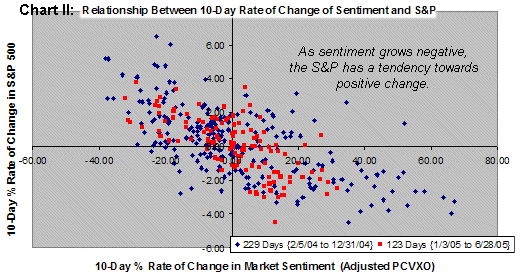
In addition to the sentiment product peaks and valleys, Chart II highlights the general inverse relationship between the S&P and the sentiment product, more specifically in their 10-day rates of change. As sentiment product drops, the S&P rises. The gist of the argument: It pays to spend some of your research time looking at the health of the market. Chart I, for example, is speaking to us now, saying the sentiment product is ready to rise and, conversely, market’s ready to fall.