TripleScreenMethod.com
The Yield Curve: Another Measure of Market Health
by Richard W. Miller, Ph.D.
appeared in June Edition of CANSLIM.net News
Last month, I wrote about two measures of market health: the NYSE bullish percent, a measure of the percentage of NYSE companies giving bullish “point & figure” signals, and the number of stocks, with shares priced greater than $10 and trading at least 100,000 shares daily, currently below their respective 200-day moving averages. Both provide measures of breadth in the market’s health. Today, I’ll add another indicator of market health, the yield curve, which works best as a leading gauge at major turns in the economy. It’s reflective of our current location in the business cycle, which, in turn, is a major driver of stock market performance.
The yield curve, a plot of interest rates of bonds at different maturities, describes the relationship among short-term, medium-term, and long-term rates at a given point in time. Typically, it depicts a line that rises from lower interest rates on shorter-term bonds to higher interest rates on longer-term bonds, as bond holders demand greater return for the longer term risks of inflation swings, political turmoil, and the uncertainty of wars. A steep yield curve, on the other hand, with longer-term rates 3 percent or greater than shorter-term rates precedes a time of vibrancy in our economy (see chart’s early 1990s and the 2002 market bottom). Today, however, as the Federal Reserve boosts rates in its continuing pursuit to quash inflation, this curve has reached its flattest point since that seen in early 2001. That’s important because a flattening yield curve often portends slowing economic growth—an inverted curve, or negative yield spread, has signaled all six recessions since 1960—and it’s death to financials, like Countrywide Financial (CFC), which profit from the spread by borrowing short term and lending longer term.
The yield spread, or gap between short- and long-term Treasures, is an often-quoted measure of change in the shape of the curve. Last May, the spread between the 3-month Treasury bill and the 10-year Treasury note reached 3.73 percentage points. As of 6/01/05, it has since tumbled 281 basis points to 0.92 as the Fed increased short-term Fed funds rates eight times in 0.25 percent increments from 1.0 to 3.0 percent, though it’s important to point out that the Treasury short-term rates remain as low as we’ve seen since 1990.
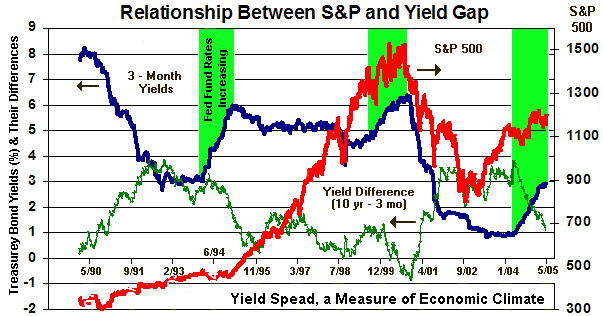
Historically though, such flattening has been the first major warning that the economy is in danger of slipping into recession. It results when the Federal Reserve raises short-term rates to combat expected future inflation (raises short term rates). Then bond holders, at some point, recognize the risk of a Fed induced recession and buy longer-term bonds to lock in higher rates that they see falling in a future Fed response (lowers long-term rates). This buying pressures causes bond values to rise and their respective rates to fall, i.e., there is an inverse relation between bond rates and bond value. The chart shows three time periods since 1990 where the Fed increased short-term rates to ward off inflation. Notice in each case, the short term notes increased yield and the yield curve flattened—evidenced here by the difference in 3 month and 10 year yields.
A fully inverted curve, like that which occurred in late 2000 (area of negative return in the difference curve) reflects the view that the Fed is keeping short-term rates too high, money is getting scarce, and an economic downturn is virtually certain. As you know, the S&P then fell 50.5 percent over the next few years. Never ignore an inverted yield curve. It forecasts the impact on GDP 4 to 5 quarters in the future.
The point of all this is that we’re there again: the Fed is tightening and the yield curve is flattening, though we’re a long way from the conventional flat yield curve to this point. A study by the Federal Reserve Bank in New York calculated the probabilities for a recession based on yield curve characteristics: if the yield curve is normal so that the 10-year Treasury bond yield exceeds 1.2 percentage points above the 3-month bill, the chance for recession is less than 5 percent; once the yield curve flattens and the two have essentially the same yield, the probability of recession increases to 50 percent; if the curve inverts where the yield on a 3-month bills is more than 2.4 percentage points above the 10-year bond, the odds leap to 90 percent than an economic downturn will materialize within the next 18 months. Traditionally, an inverted curve--with higher short-term rates than longer yields--indicates an extremely tight Fed policy, which the market anticipates will be loosened soon so the mentality is lock in long-term rates now (increased demand for longer-term Treasuries causes bond prices to rise and their rates to fall. But that's not where we are now.
Just remember: anything that increases the demand for long-term Treasury bonds puts downward pressure on interest rates (higher demand = higher price = lower yield or interest rates) and less demand for bonds tends to put upward pressure on interest rates. A stronger U.S. economy tends to make corporate (private) debt more attractive than government debt, decreasing demand for U.S. debt and raising rates. A weaker economy, on the other hand, promotes a “flight to quality,” increasing the demand for Treasuries, which creates lower yields. Interestingly, an increasing Federal deficit results in an increasing supply of longer-term Treasuries and higher interest rates.
The major factor pressuring longer term rates today is the foreign demand for longer term U.S. Treasuries. Fifteen major markets, including Greece, Italy and Taiwan, have lower bond rates than the U.S. And lower foreign rates encourage foreign investors to buy U.S. Treasuries in their search for better returns. Too, bond yields have fallen to all-time lows in the six-year-old euro zone, as investors expect that the European Central Bank will cut interest rates soon because of stagnating growth. Japan's bond yields remain close to 1 percent as that country's deflation persists. The foreign demand drives the longer-term yields down.
Though interest rates remain lower than we’ve seen over the period shown in the cart (3-month yields), I think that you would agree, it pays to be aware of the yield curve shape, especially when the Fed starts tightening. Yield curve shape makes a statement about the current economy, and the economy impacts corporate profits, hence, the stock market which is directly related to the economy.
View the current yield curve at http://www.stockcharts.com/charts/YieldCurve.html.