TripleScreenMethod.com
Using Business Sector Information
Richard W. Miller, Ph.D.
Conventional wisdom tells us to buy stocks breaking out to new highs and to buy the best stocks in the best performing sectors. The TSM approach produces a watch list of stocks that have three things going for them: (1) fundamentally sound from a historical perspective, (2) positive earnings and/or analysts' revision fuel (Zacks screen), (3) value left at their current price (two year PEG ratios). For the most part, these TSM stocks also are in the best performing industry sectors as well.For about a year now, I've been collecting business sector performance charts like those presented in daily TSM reports. Each chart places the 31 business sectors into quadrants: the upper right quadrant (Best) has positive 1- and 3-month returns; the lower right quadrant (Falling) has positive longer term but negative short term; the lower left quadrant (Worst) has both short and longer term negative performance; the upper left quadrant (Improving) has a positive short but negative longer term performance. The "Best" quadrant is where you'll find stocks reaching their peak performance, but it's also where stocks are most at risk to a market turn down. On the other hand, the best stocks in the "Worst" quadrant are where new high performers are likely to come from in 2005. This quadrant at the same time provides less risky entries, since they are already at their low point. Consider the following plot which charts the performance of the Materials & Construction sector over time.Of course, the best stock/best sector argument works best in an bullish trending environment. Truthfully, it's like printing money. But the current market is more difficult. You get in, ride up a bit, then it suddenly reverses and stops out everything you're holding. So I continue to look at entries less risky than the breakout to new highs and ones that perform better: the 21-day low and the hammer candle pullback are two. The advantage the TSM approach offers is this combination of quality stock sand good technical entries. Not only does it make intuitive sense, but it also has a good performance record (233 trades with 58.4 percent win rate, average hold period 9.1 days and average return +39 percent annualized for 2004 and 174 trades with 64.4 percent win rate through the 3rd quarter of 2005). Today, I write about how sector information might be used.
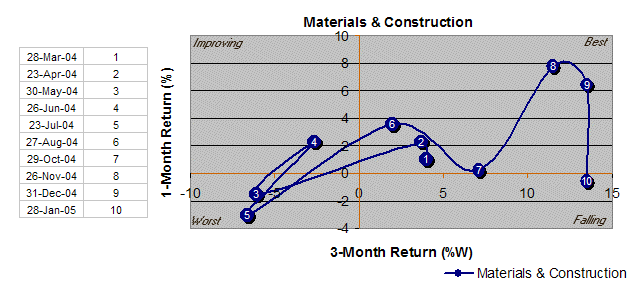
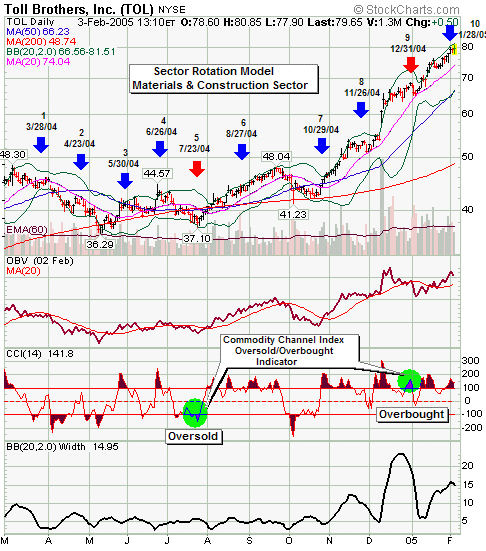
TOL is a member of the Materials & Construction Sector. Each arrow shows where it was at the 10 positions in the sector diagram. Positions 6, 7, 8 and 9, in particular, fall in the 'Best" quadrant, but TOL position 10 (the current position) marks a "Falling" performance for the sector, i.e., the Materials & Construction sector is clearly at risk here. Seven members from this sector are in the current TSM list and bear watching. Notice, position 5, an extremely oversold position, offered the ideal entry point from both a performance and a risk stand point.
Electronics and Internet are two sectors currently in the "Falling" quadrant. Watch for technical buying opportunities: Electronics (AMXC, MRVL, STST, TRMB, XXIA) and Internet (FFIV, GOOG, IIG).