TripleScreenMethod.com
Quad IV Sector Rotations : An Example of Sector Consolidation
from www.CANSLIM.net (published February 2007)
Richard W. Miller, Ph.D.
In the December 2006 issue of CANSLIM.net
News (“Three-Year Trends in Sector Rotation”), I updated my research aimed at
understanding month-to-month sector rotation cycles. Here, I will exploit that
understanding to formulate a short-term trading strategy for fundamentally
sound, CANSLIM stocks. As I pointed out there, macro-rotation cycles drive the
market from one group of stocks to another, regardless of company fundamentals.
This rotation cycle, however, tends to be cyclic (both long term and short
term), hence the trend can be recognized and more importantly traded.
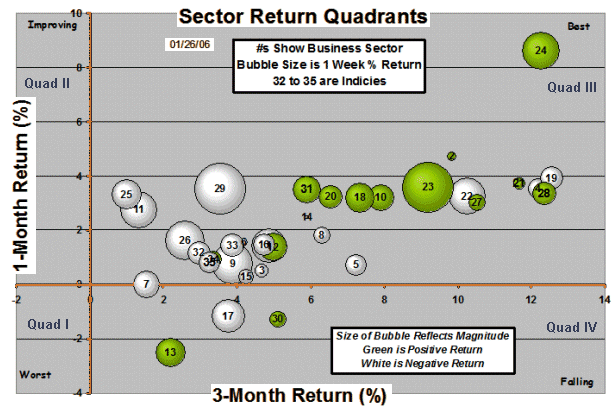
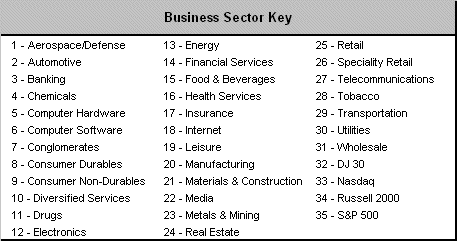
For example, consider the 1/26/07 Sector Return Map shown in the chart. Four areas (called quads) define sector performance over their past one- and three-month periods: quad I (both returns negative [sectors bearish]), quad II (1 month positive, 3 month negative [sectors breaking out]), quad III (both returns positive [sectors bullish]), and quad IV (1 month negative, 3 months positive [sectors pulling back]). The accompanying business sector key identifies the numbers encircled on the chart.
Though there has been a strong tendency over the past 13 quarters for a sector to remain in bullish quad III (4,309 sector readings found there in 54.5% of the weekly charts with 18.6% in quad I, 11.6% in quad II and 15.3% in quad IV), just like strongly performing stocks, sectors consolidate their gains periodically. One way they do that is to pull back into quad IV. So the question one should ask is whether this consolidating sector is more likely to resume its bullish ways and jump back into quad III, remain in quad IV for a while or continue its down performance into quad I. Markov Chain Analysis tells us the relative probabilities for 2006 were 0.48, 0.17 and 0.33, respectively, that a sector would be in quad IV one month then move into quad III, stay in quad IV or fall into quad I over the next month. Let’s extend this type analysis to weekly run lengths.
Weekly run lengths answer questions like: If a sector is in quad IV this week, how long is it likely to remain in there? And after its run in quad IV, where’s it most likely to transition to? Over the past 13 quarters, there were 297 quad IV sector runs, i.e., where a given sector remained in quad IV from one to six weeks. As to length of run, 51.9% of these quad IV runs ended after one week, 23.2% after two weeks 13.5% after three weeks, and 11.4% ended in four to six weeks. These quad IV runs ended by entering quad III (68.0%), quad I (27.3%) or quad II (4.7%). That is, more than two-thirds of the time a sector pulling back into quad IV will resume its bullish run and re-enter quad III. A good way to play this rotation is to identify quality stocks in quad IV sectors and watch as bases form then break out with the sector.
As you can see in the chart, sector 17 (Insurance) is currently in quad IV and was one of the poorer performers last week (color and size of bubble). AMSF from that sector is an ideal candidate to breakout as this sector rotates from quad IV. After I published this article, look what AMSF did on 2/1.
