TripleScreenMethod.com
Current Monthly Trading Article
(appeared in November '04 issue of CANSLIM.net News)
Trading Quality Stocks in Today's Market:
Buying 21-Day Lows of Fundamentally Sound Stocks
by
Richard W. Miller,
Ph.D.
Last month I reviewed results from How Markets Really Work: A Quantitative Guide
to Stock Market Behavior, a new book by Larry Connors and Conor Sen that
contrasts the relative merits of buying new highs versus new lows in the S&P
cash index. You recall, they presented 15 years of historical data (1/1/89
through 12/31/03) refuting much of what passes for "common market truisms."
These authors looked at several market criteria (new 5- and 10-day highs and
lows, the impact of being above or below the 200-day moving average, multiple
day pullbacks, and others) to evaluate how each impacted one day through
one-week returns for the S&P 500 and Nasdaq 100 cash markets. Most of what they
found went against our dearly held market beliefs. The authors put it this way:
"...the greater opportunity and edge lies in being a buyer as the market makes a
new short-term low versus buying when it makes a new high."
Following this theme, I tested three common patterns used for entering long positions in individual stocks: three or more day pullbacks, new 21-day highs (breakouts), and new 21-day lows (bottom fishing). To validate this study, I studied these three patterns for a group of fundamentally sound stocks (9/24/04) with earnings and analysts’ rankings revision fuel (Zacks rankings of 1 or 2) and value left in price (two year PEG ratios less than 1.25): 36 stocks were evaluated over the 294-day period between 7/30/03 and 9/28/04 (10,584 test days).
For these 36 stocks, the average 5-day gain for a control condition, defined as going long when today’s price exceeded yesterday’s high, was +1.27 percent. Limiting buys to pullbacks increased returns to +1.84% (1.45x the control), to new 21-day highs increased returns to +1.38% (1.09x the control), to new 21-day lows increased returns to +2.59% (2.04x the control). Clearly, in this market, buying the new 21-day lows for a week-long trade was a superior strategy to either buying pullbacks or buying breakouts. These results are consistent with Connor’s findings for 15 years of S&P data.
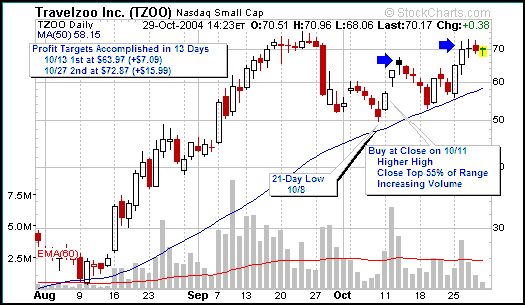
This month, I report the results from trading the 21-day low setup for quality stocks in short-term pullback. From 10/07 through 10/22, I cross-screened using an earnings fundamentals and earnings revision screens, a price greater than $10, and average volume greater or equal than 100k. About 200 stocks, each with quality fundamentals and bullish price performance, were then assessed as to whether they were making new 21-day lows. Each day, the final trading list had 4 to 10 stocks. Trades were made when one or more of these demonstrated reversal power, i.e., after the following criteria were met: over the next five days, (1) today’s high must exceed yesterday’s high, (2) today’s close must be greater than today’s open and in the top 55 percent of today’s trading range, and (3) today’s volume must exceed yesterday’s. If the trade is to occur on the fifth day following the 21-day low and the risk is greater than 10%, the trade is not taken.
When these conditions were met—and the reversal strength indicated—I then bought at the close of the day, set a stop loss just below the minimum of the last few days (usually just below the 21-day low), set a first profit target as the purchase price plus the difference between purchase price and the stop (1-to-1 risk/reward), and a second profit target at the recent pattern high close before the new low was made. Note, one-half of the position was closed at each target. When either profit target was reached, one-half of the position was sold. The following Chart for TZOO demonstrates the most profitable trade.