TripleScreenMethod.com
TASR: a Study in Float Analysis and Short Interest
CANSLIM.net (April '04 Issue)
Taser International develops, assembles and markets less-lethal, conducted energy weapons primarily for use in the law enforcement and corrections market. The company's primary product is the Advanced Taser, an non-lethal hand weapon (sometimes referred to as a “stun gun”) designed primarily for the law enforcement and corrections market. The recent trading action in this particular stock is an excellent example for float analysis as it relates to short interest. This article is not a recommendation to purchase or sell TASR. We are using this stock strictly as an example
Based on data from law enforcement testing, the use of stun guns has led to an 80% decrease in officer injuries, 67% decrease in suspect injuries, and 78% decrease in deadly force. In a time of heightened security and frequent terror alerts, and a focus on homeland security, its industry group continues to perform well.
Earning's fundamentals for this stock are strong and Zacks ranks it a 2, and, as evidenced in the next two year PEG ratios (0.60 for ’04 and 0.92 for ’05), substantial value remains. Currently too, the company’s industry group ranking has been moving higher. TASR is a fundamentally sound stock that retains substantial value. Couple that with the fact that they have virtually no competition, it’s easy to understand the level of interest that’s come into this stock. Here, I want to talk about TASR’s trading characteristics: specifically, the unusual degree of short interest and the high float turnover rate.
Short interest provides built in buying pressure, as shorts must cover at some point. That point is likely to be reached sooner rather than later with a stock of TASR’s fundamental characteristics and sector strength. Notice the level of short interest each month since November. Most recently, 38.8% of TASR’s float was held short.
With each positive event, like the 3-1 split on 2/11 (labeled 1) or the approval to trade on the Nasdaq big board (and the decision to trade options - labeled 2), the price break out was fueled by accumulation, presumably too, by short covering. The latter added fuel to the fire, producing what’s commonly known as a “short squeeze.” Notice here also the price and On Balance Volume (OVB) bullish divergence: as labeled at 2, the OBV broke to a new high, while the breakout price didn’t, a sign of bullish things to come.
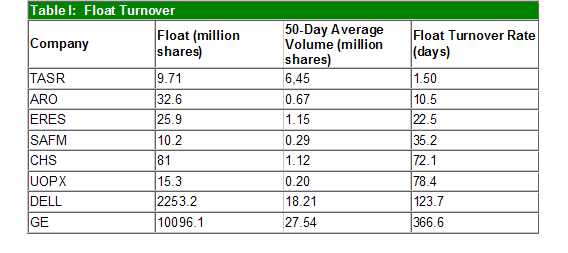
The combination of fundamentals, value, and the degree of short interest combine to generate much interest in trading TASR shares. The accompanying table shows the number of days required to trade several company’s entire float, given the average volume of each. TASR has been trading its entire float every 1.5 days. Compare that to GE’s every 366.6 days. Float turnover rate is often related to a stock’s technical pattern. As price traces out a congestive base, weaker hands sell to stronger ones; the stronger hands hold for the next run up; and the float turns over between the two. That’s not the case for TASR. As seen in the figure, various technical regions (resting bases and breakout thrusts) are marked with blue horizontal lines. Note how rapidly the float is turning in each of these: since splitting 3-for-1, TASR has turned its float 26.3 times in 36 days.
This unique combination of fundamentals, value, short interest, and float turnover has created an environment where the daily range frequently exceeds ten dollars. While these conditions are a short-term trader’s nirvana, controlling risk is extremely difficult and market maker games are plentiful (frequently, the MMs must take the other side of TASR’s wild rides, shorting the climb and buying the drop only to flatten their positions the next morning by controlling the opening). In TASR’s case, let both the buyer and seller beware.
Send an email to rmiller@triplescreenmethod.com.
